Information technology plays an extremely complex role in organizations. We require it to give us instructions on when and where to carry out production operations; to map where funds are flowing; and to identify areas of the market that we can effectively target. Not only is every member of the organization dependent on technology in some way; but the systems also ensure connection with the entire ecosystem in which the company operates.
For many organizations in the Czech Republic and abroad; the functioning of their information systems is a nightmare. They need to make changes that will support their processes; increase production efficiency or offer goods to new customers. They start preparing a project plan and realise that they will need to make adjustments using an application that will support these new requirements. But wait – the cost of this change on the IT side starts to rise to astronomical heights; the return on investment exceeds the lifetime of the universe; and the deadline for its implementation corresponds to this time horizon. How is this possible? After all; when we implemented the information system five years ago; we saw how much work it would save us; how it would increase our efficiency and become our indispensable support for everything we do. What has happened in the meantime?
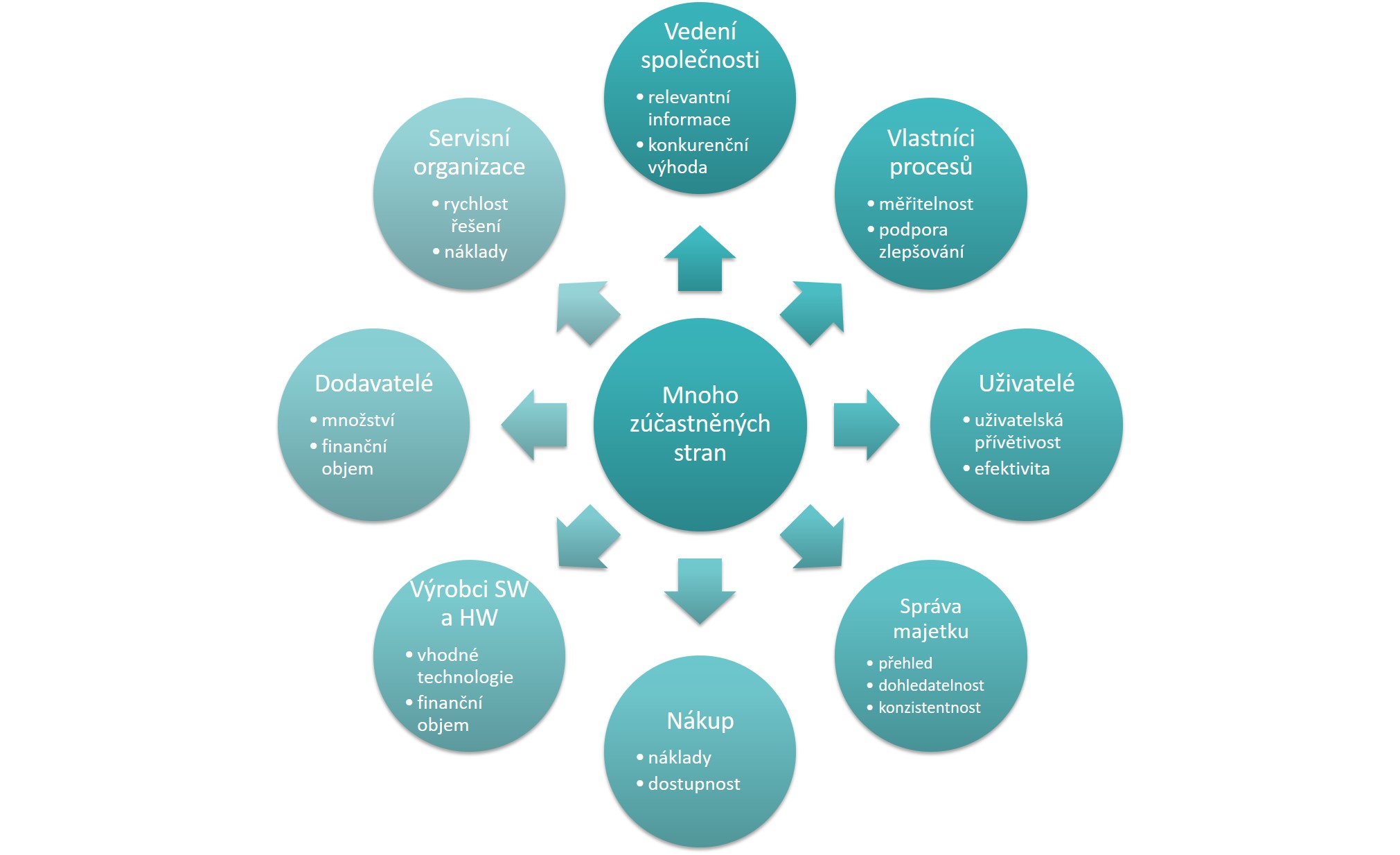
The first answer that comes to mind is to find the "culprit" in your IT department and among your external suppliers; who; in your opinion; have hooked you and are now holding you captive; squeezing you dry and not delivering what you need. Unfortunately; as is often the case; this answer is not correct. This dependency is merely a consequence of our poor planning and approach to this area. The truth is that fighting fire with fire does not work here; instead; we need to take a comprehensive approach to the solution; looking several years ahead.
Cost structure
Every year; we spend considerable amounts of our budget on the development of information technology. What is the basic structure of these costs?
- Approximately 20% of our costs are spent on hardware and its operation. These are costs for which we receive something physical; i.e. at the end of the day; we have a "box" – a laptop; desktop computer; server or network element.
- Another 20% of our costs are spent on software technologies – operating systems; virtualisation platforms; databases and licenses for specific applications.
- The largest part; approximately 60% of our costs; is spent on system administration – ensuring that the system is functional and works according to our requirements. This is mostly purely human labour; performed by someone who is educated in this field. This part also accounts for the largest amount of inefficiently spent funds; which is closely related to the quality of the people we hire. As a specific example; I can cite my own experience; where the supplier of a malfunctioning system recommended that the client purchase hardware and a higher-class database to solve the problem; at a cost of five million CZK – which was approximately double the annual IT budget. The client asked us to verify the proposed procedure; and after analyzing the performance of the database server; we had to conclude that the problem was not in the technology; but in the way the code was written. After modifying it; the system provided the responses required by the customer; and five million was not wasted. Incidentally; this purchase would not have solved the problems at all.
In the first two points; changing suppliers is possible; and analysis can clearly tell us whether the change will pay off. In the third point; it is not so simple.
How does dependence on our supplier arise?
Although we often think of a supplier as an external entity; we may also become dependent on our internal supplier. This could be; for example; a specific developer who is our employee.
It is good to realise right from the start that this dependency can be both unhealthy and symbiotic; i.e. beneficial to both parties. Nevertheless; I believe that the customer should always have the entire area under their own control; and a person from the company's top management must be responsible for it.
So; how do we become dependent?
- Consciously – we do not have knowledge in a given area and it is not worth maintaining it. It is clear that if we have a single database from Oracle in our company; then it is cheaper to hire a specialist for a few hours a month to perform the tasks necessary for its operation. This saves us the cost of training our employees; and a specialist who only deals with this technology in several organizations is able to solve these problems routinely; quickly and efficiently.
- "Short-term solutions" – short-term and small solutions have the characteristic of growing very quickly and soon spreading throughout the entire company. It started with the creation of a database of our existing and business partners. After some time; we asked for the ability to track the activities we carry out with these contacts – so the supplier programmed a new module according to our ideas; then came the tracking of service requests; communication via EDI... And suddenly; a small supplier became a supplier of a key application. No one in the company knows exactly how it works; and only one programmer has an idea of what is there; where the data flows from and to; and what happens to it.
- Using only one supplier – if we have defined the services that the supplier performs for us and the related SLA (Service Level Agreement); then nothing happens. As part of the consolidation of suppliers; we have most likely obtained more favourable terms. Unfortunately; 90% of companies have no idea what their supplier does for them. Neither the services nor the SLA are described; and as a result; they have lost control over their key processes and their IT support.
- Supplier's intention – To be honest; I have never encountered this case. However; the fact is that if a supplier settles in with a customer who does not pay attention or devote energy to this area; they can take advantage of this situation and manipulate the client into such an unequal relationship.
The risks of unhealthy dependence on an IT supplier are the same as in any other case:
- Loss of control over delivery deadlines and quality – we have to coordinate all our requirements and their fulfillment with a specific supplier. If they are overloaded; they may not be able to deliver to the extent and within the time frame we require.
- Departure of a key person – the developer who was the only one familiar with our application decided to change his lifestyle and left to meditate in India. What can we do about it?
- Impossibility of supplier competition – we would like to find a new supplier; but we have no idea how to organize a competition because we do not know what to ask for and how. Due to the general assignment; the new supplier must factor the risk into the price; which makes their offer more expensive. Isn't that a shame?
- Loss of company autonomy and creation of competitive advantage – let's go back to the beginning of my blog. Those who create our systems decide our competitiveness. We only get what the supplier is able to deliver; not what we really want and demand.